
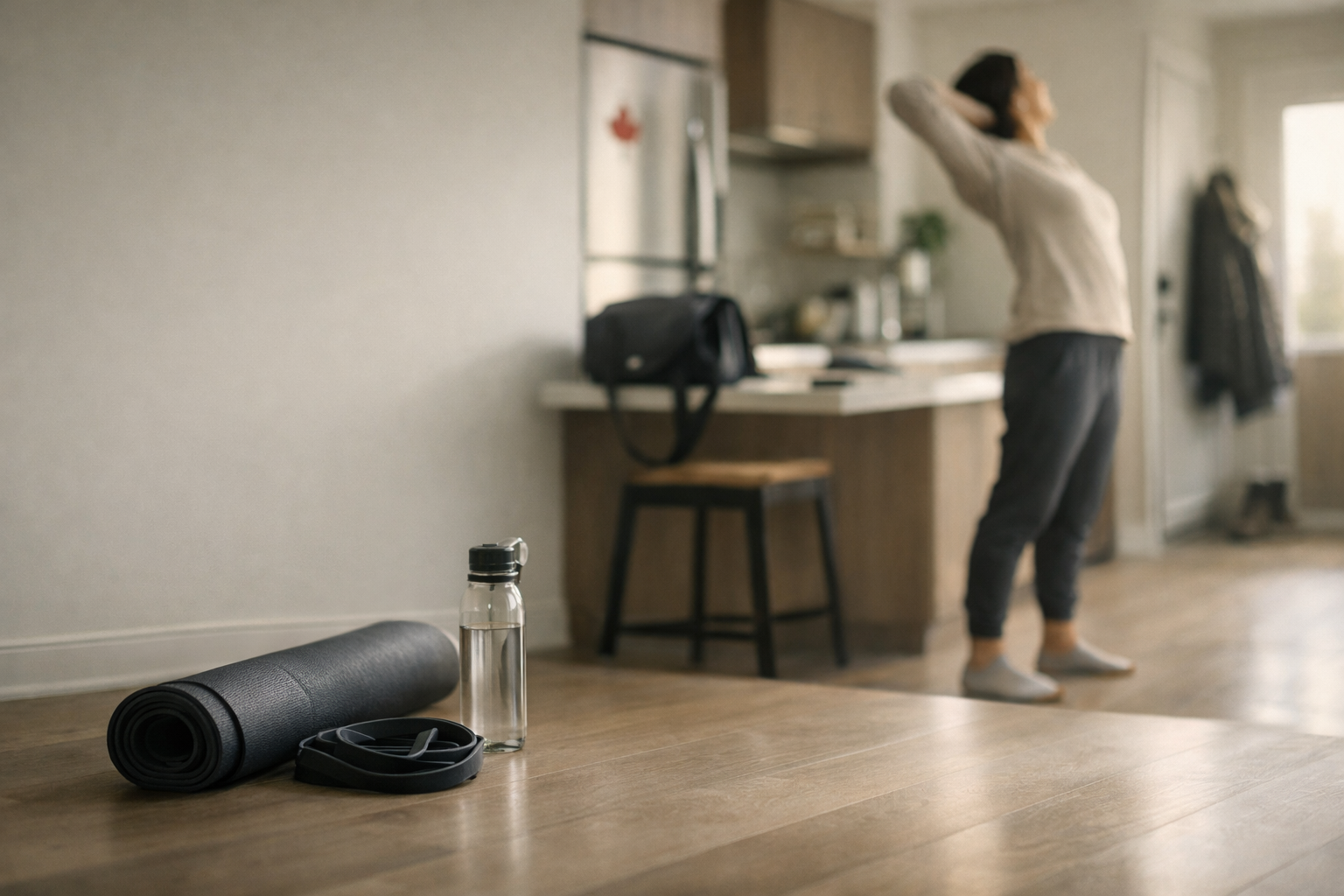
If you’ve ever told yourself “I’ll work out when I have more time” but only keep putting off working out, you are not alone. The data backs up what a lot of people already feel day to day: most of us want to be more active, but life has other plans.
How active are Canadians right now?
An Ipsos survey paints a pretty clear picture.
- 40% of Canadians aged 25–64 say they get less than 30 minutes of physical activity per day.
- 6% say they get no exercise at all.
- On the other end, 37% report 30–59 minutes daily, and 8% say they’re active for over two hours a day.
So we are not “inactive” as a country as a whole, we are split. While a lot of Canadians are moving regularly, there is still a significant chunk missing their movement goals.
The regional details are even more telling with Quebec reporting the lowest activity levels on average. 64% of people getting under 30 minutes a day. That’s not a moral failure rather a signal that environment, routine, season and commute are cutting into the time in their day.
The real obstacles are not what you want them to be
When people say they “just need motivation,” what they often mean is “I need a plan that fits my life.”
The survey found the biggest blocker is exactly what you’d expect:
- 75% said lack of time is the main reason they do not exercise more.
Then come the answers people feel guilty saying out loud:
- 29% said laziness gets in the way.
- For ages 25–34, that number jumps to 42%.
But “laziness” is usually not laziness. It’s friction. It’s decision fatigue. It’s not knowing what to do, or feeling like anything less than a full workout does not count.
Other barriers were also clear:
- 22% said they simply dislike working out.
- 9% said they’d exercise more but need help to work out.
- Another 9% said they need someone to motivate them, but do not have anyone to exercise with.
That’s a lot of people who are not asking for more discipline. They’re asking for fewer obstacles.
Canadians prefer to exercise alone and from home
This part is interesting because it sounds contradictory until you’ve lived it.
- 73% say they prefer to exercise on their own.
- At the same time, 64% say working out with others is a great motivator.
Translation: many Canadians want support, not necessarily company. They want accountability and encouragement without the awkward scheduling, gym anxiety, or feeling like they are “performing” fitness.
There are also regional differences here. British Columbia is the most likely to work out with others, with only 32% saying they prefer to exercise alone.
And then there’s the big one:
- 77% prefer the convenience of exercising from home.
- 70% say they’d exercise more if they could do it from home.
That lines up with what many people experienced during the pandemic. More time at home made it easier to squeeze movement into the day, even if it was short.
So what do we do with this?
If time is the biggest obstacle, the solution is not “try harder.” The solution is to make exercise smaller, simpler, and easier to start.
A few practical shifts that work for real schedules:
- Lower the entry fee. Ten minutes counts. So does five.
- Remove setup friction. Keep a band, mat, or wraps where you can see them.
- Make it repeatable. Same time, same place, same “default” routine.
- Track it lightly. Not for guilt. For momentum.
That’s the whole point of what we’re building at Elysautus: gear that’s easy to use, and simple trackers that help you stay consistent without turning your life into a bootcamp.
Want updates when new guides and trackers drop?
Join our email list and we’ll let you know when new routines, tools, and Elysautus trackers go live.